
Venue: daphne Indigenous artist-run centre (5425 Av. Casgrain Unit 103, Montreal, Quebec H2T 1X6) Date: October 3, 2026 Time: 2:30 PM – 4:30 PM
Facebook Event: https://www.facebook.com/events/1062698383041837
Co-presented with daphne Indigenous artist-run centre and the International Institute for Critical Studies in Improvisation.
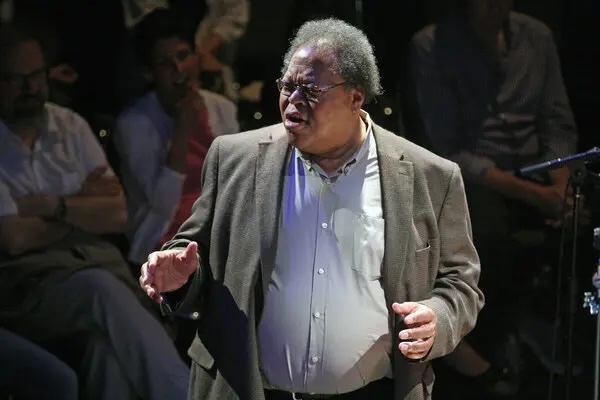
Join us for a keynote presentation by George Lewis entitled ‘Archiving The future: There Are Black Composers In The Future: Afrodiasporic New Music and the Heterogeneous Sound Ideal.’
The writings of African American composer Olly Wilson (1937-2018) exercised enormous influence in proposing an African-American musical aesthetic in contemporary classical music. Wilson portrays Afrodiasporic music-making as exhibiting “shared conceptual approaches,” which he eventually subsumes under his notion of the “heterogeneous sound ideal…a fundamental bias for heterogeneity of sound rather than similarity of color or homogeneity.”
An influential 1991 essay by art historian Robert L. Douglas, while not referencing Wilson’s work, proposes something quite similar in the visual arts, with his notion of “multidominant elements,” or “the multiple use of colors in intense degrees, or the multiple use of textures, design patterns, or shapes.” For Douglas, multidominance is well described with reference to multiple meters in traditional African music, but he uses the concept to contextualize the work of the Africobra artists who began their work in the late 1960s, including Jeff Donaldson, Wadsworth Jarrell, Jae Jarrell, and Barbara Jones-Hogu. Moreover, both Wilson and Douglas may be placed in intersection with art historian Robert Farris Thompson, who saw the black Atlantic visual tradition—for example, Akan asadua cloth, woven using narrow, multistrip patterns–as displaying “a propensity for multiple meter.”
Wilson presents numerous examples of the heterogeneous sound ideal in a wide range of African and African American musical practices, with the curious exception of contemporary music—his own primary field. His 1970 orchestra work Voices, however, exemplifies many of the tendencies he identifies; its swirling, repetitive sonic behaviors and uncanny effects are only one part of the work’s overall heterogeneity of sound and color. The main direction in this talk, then, is taken directly from Wilson’s piece. Through examples from the work of a diverse (and by no means exhaustive) range of Afrodiasporic contemporary composers, I want to identify aesthetic directions that appear frequently in Afrodiasporic contemporary classical music since 1960, connecting these with larger issues in the creolization of the field as a whole.
daphne is an Indigenous artist-run centre in Tiohtià:ke / Mooniyang / Montreal. Through exhibitions and related programming, we promote contemporary Indigenous art and artists. We favour critical, respectful exchange with our various communities, peers and audiences, to advance a culture of peace. daphne gratefully acknowledges the support received from all our relations, families, friends, communities, the Conseil des arts de Montréal, the Canada Council for the Arts and the Conseil des arts et des lettres du Québec. Niá:wen sewakwé:kon / Gichii miigwetch / Thank you to all of you.